
Table Of Contents
- Quick Answer: Wrinkle Treatment at a Glance
- What Wrinkles Actually Are, and Why They Form
- How Wrinkles Show Up Day to Day
- What Drives Wrinkles: Understanding “Why Me?”
- Red Flags: When Skin Changes Need Urgent Medical Attention
- How We Assess Your Skin and Facial Anatomy
- Your Personalized Wrinkle Treatment Plan
- What the Evidence Says, in Plain Language
- A De-Identified Patient Story
- Meet Your Surgeon
- What Our Patients Say
- Watch: Why Wrinkles Happen and What Can Be Done
- Download Our Free Wrinkle Treatment Planning Guide
- Wrinkle Treatment FAQs
- Booking Your Consultation in Oakville
Quick Answer: Wrinkle Treatment at a Glance
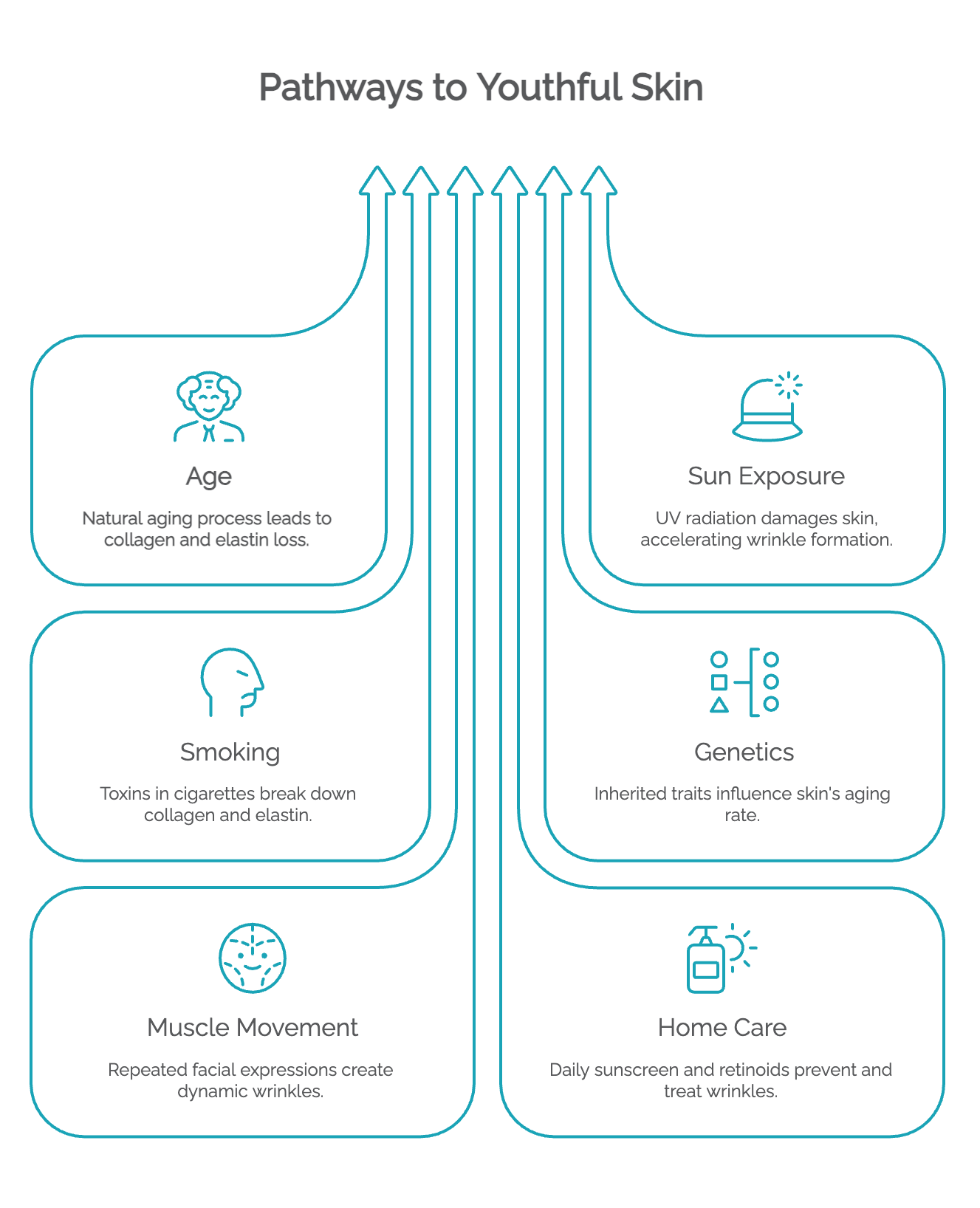
Wrinkles are creases that form as skin loses collagen, elastin, and underlying volume, and as repeated facial expression etches lines into the surface. The main drivers are age, sun exposure, smoking, genetics, and muscle movement. First-line care starts with what you do at home: daily broad-spectrum sunscreen, a retinoid, and not smoking. In-clinic options include neuromodulators such as Botox Cosmetic for dynamic lines, hyaluronic acid fillers for volume loss, and energy-based resurfacing for texture. Results vary, and no treatment stops aging. Seek urgent care for sudden facial drooping, vision changes, severe pain or skin blanching after an injection, or any new, changing, or bleeding skin lesion.
What Wrinkles Actually Are, and Why They Form
Skin has three working layers. The epidermis is the visible surface. Beneath it, the dermis holds the collagen and elastin that give skin its firmness and snap. Below that sits a layer of subcutaneous fat that provides cushioning and shape. Wrinkles are what happens when all three layers change at once.
Starting in our twenties, collagen production begins to slow, and elastin fibres become fragmented and less springy. The dermis holds less hyaluronic acid, so skin retains less water and looks thinner and drier. At the same time, the deep fat pads of the face descend and shrink, and the underlying bone of the midface, orbital rims, and jawline slowly resorbs. The result is less structural support beneath the skin, so the surface folds where it once stayed smooth.
Layered on top of that is movement. Every time you raise your brows, the frontalis muscle contracts and the skin above it creases. Every squint recruits the orbicularis oculi. Every frown pulls the corrugator supercilii and procerus muscles together. Repeated thousands of times over decades, those creases become permanent.
That distinction matters clinically, because it separates wrinkles into two categories.
Dynamic wrinkles appear when you move and disappear when your face is at rest. They are driven by muscle activity, and they generally respond well to neuromodulators.
Static wrinkles are visible even when your face is completely relaxed. They reflect true structural change in the dermis and the tissue below it, and they usually need volume replacement, collagen stimulation, resurfacing, or in some cases surgery.
Most people arrive with a mix of both, which is why a single treatment rarely addresses everything.
Two Myths Worth Clearing Up
Myth: Expensive creams can remove deep wrinkles. Topical products can meaningfully improve texture, tone, hydration, and fine lines, and topical retinoids have real evidence behind them. What no cream can do is replace lost volume or lift descended tissue. Marketing language that promises a “surgical result in a jar” is not describing what topicals are capable of.
Myth: Starting treatment too early will make things worse. There is no evidence that appropriate, conservative neuromodulator or filler treatment accelerates aging. What can look worse over time is overtreatment: too much product, too frequently, without a plan. The goal is a face that still moves and still looks like you.
How Wrinkles Show Up Day to Day
Patients rarely come in asking about collagen density. They come in because of something they noticed in a photograph, a video call, or the bathroom mirror at the end of a long day.
The most common concerns we hear:
- Forehead lines. Horizontal lines across the forehead that used to appear only when the brows lifted, and now stay put. Deep forehead lines are often the first change patients name.
- Frown lines between the brows. The vertical glabellar lines, sometimes called the “11s,” that can read as anger or worry even in a neutral face.
- Crow’s feet. Fanning lines at the outer corners of the eyes, most visible when smiling.
- Tired-looking eyes. Hollowing in the tear trough, crepey lower eyelid skin, and a heaviness in the upper lid that makes eye makeup sit differently than it used to.
- Lines around the mouth. Fine vertical perioral lines on the upper lip, which can cause lipstick to feather.
Nasolabial folds and marionette lines. The creases running from nose to mouth corner, and from mouth corner down toward the jaw. - Neck and jawline changes. Loose skin on the neck, vertical platysmal banding, and softening of jawline definition.
Patterns Patients Notice
Wrinkles look worse when you are dehydrated, sleep-deprived, or under stress, and after a weekend in the sun. Many patients tell us their skin looks best in the morning and most creased by evening, which is largely a hydration and fluid distribution effect rather than a change in the wrinkles themselves. Harsh overhead lighting and front-facing phone cameras exaggerate shadows in every line on the face. None of these fluctuations mean a treatment has failed or that skin is deteriorating rapidly.
The Functional Side
The word “cosmetic” undersells how these changes land. Patients describe avoiding photos, turning the camera off in meetings, and being told they look tired or upset when they feel neither. In some cases the effect is genuinely functional: significant upper eyelid skin can encroach on the visual field, and that is a medical assessment rather than an aesthetic one. Discomfort with your appearance is a legitimate reason to seek care, and it is also a reason to take treatment decisions seriously rather than quickly.
What Drives Wrinkles: Understanding “Why Me?”
Two people the same age can have very different skin. Understanding what is driving your particular pattern is what makes a treatment plan effective rather than generic.
Intrinsic Aging
This is the biology you inherited. Collagen synthesis declines steadily with age, elastin does not regenerate meaningfully once damaged, and the rate at which this happens varies by genetics and by Fitzpatrick skin type. Fair skin types tend to show fine lines and laxity earlier, while richer skin types often show pigmentary change before textural change. Perimenopausal and menopausal hormonal shifts also accelerate collagen loss, which is why many patients notice a steep change in their forties and fifties rather than a gradual slide.
Sun Exposure and Photoaging
Ultraviolet radiation is the single largest modifiable contributor to wrinkling. UVA penetrates into the dermis and degrades collagen and elastin directly. The Government of Canada’s sun safety guidance identifies UV exposure as a primary driver of premature skin aging as well as skin cancer, and recommends broad-spectrum SPF 30 or higher, shade, and protective clothing. A lifetime of driving with one arm at the window is a visible, and unfortunately reliable, demonstration of this.
Muscle Movement and Mechanical Load
Expression is not a flaw, but it is a load. The same repeated folding that creates a crease in a piece of paper creates one in skin that has less collagen to spring back with. Sleep position matters too: side and stomach sleepers often develop asymmetric vertical cheek lines from years of compression against a pillow.
Lifestyle Contributors
- Smoking constricts dermal blood supply and directly degrades collagen. It is strongly associated with premature facial wrinkling.
- Alcohol dehydrates and contributes to inflammation and vascular change.
- Sleep debt and chronic stress raise cortisol, which impairs the skin’s repair processes.
- High-sugar diets contribute to glycation, a process where sugar molecules bind to collagen fibres and make them stiff and brittle.
- Significant weight fluctuation changes the volume the skin envelope has to accommodate, which can leave laxity behind.
A Repair and Recovery Mismatch
The useful way to think about all of this: your skin is constantly being damaged and constantly repairing itself. Wrinkles appear when the damage load consistently outpaces the repair capacity. Sun, smoking, and poor sleep raise the damage side. Sunscreen, retinoids, and good general health support the repair side. Most in-clinic treatments work by either reducing load, as neuromodulators do, or by deliberately triggering the repair pathway, as microneedling, lasers, and biostimulators do.
Red Flags: When Skin Changes Need Urgent Medical Attention
Most wrinkle concerns are not urgent. A small number of presentations are, and we would rather you overreact than wait.
Go to an emergency department immediately if you experience:
- Sudden facial drooping, weakness on one side, slurred speech, or a sudden severe headache. These are stroke symptoms, not cosmetic ones, and they are a medical emergency.
- Any vision change after a facial injection, including blurred vision, double vision, vision loss, or severe eye pain. This is a rare but recognized complication of dermal filler that requires immediate assessment.
- Severe pain, skin blanching to white, or a dusky, mottled, or net-like discoloration in the treated area during or after filler injection. These can indicate a vascular occlusion, where filler has compromised blood supply to the skin. Time matters enormously here.
- Difficulty swallowing, difficulty breathing, slurred speech, or generalized muscle weakness in the days or weeks after a botulinum toxin injection. Health Canada requires a boxed warning on botulinum toxin products regarding the distant spread of toxin effect. It is very rare with cosmetic dosing, and it still warrants emergency care.
- Spreading redness, heat, swelling, fever, or pus at a treatment site, which may indicate infection.
Book a medical assessment promptly, though not emergently, if you notice:
- A new mole or spot, or an existing one that changes in size, shape, colour, or border
- A lesion that bleeds, crusts, itches, or does not heal within a few weeks
- A rough, scaly patch on sun-exposed skin that keeps coming back
- Asymmetry, lumps, or nodules that appear weeks to months after an injectable treatment
- Persistent drooping of an eyelid or brow after a neuromodulator
How to escalate: For emergencies, call 911 or go to your nearest emergency department. For urgent concerns following a treatment performed at our clinic, contact us during clinic hours and tell reception that this is a post-procedure concern so that it can be triaged appropriately. For suspicious skin lesions, your family physician can assess and refer to dermatology. Cosmetic clinics are not a substitute for skin cancer screening, and no reputable clinic will treat a lesion cosmetically without first ruling out what it might be.
How We Assess Your Skin and Facial Anatomy
A consultation should feel like a clinical appointment, not a sales appointment. Ours is structured, and it is complimentary.
History
We start by asking what specifically bothers you, and we ask you to point to it in a mirror. Patients and clinicians often disagree about which feature is the problem, and yours is the opinion that matters. From there we cover:
- Your medical history, including autoimmune conditions, neuromuscular disorders, bleeding disorders, and pregnancy or breastfeeding status
- All medications and supplements, with particular attention to blood thinners, fish oil, and anything that increases bruising risk
- Prior cosmetic treatments, including what was used, where, when, and how you responded
- Any history of cold sores, keloid scarring, or previous adverse reactions
- Sun exposure history, smoking status, and current skincare routine
- Your timeline, including any event you are working toward
- What you are hoping for, and what you would consider a poor outcome
That last question is one of the most useful ones we ask.
Physical Examination
We assess your face at rest and in motion, because that is the only way to separate dynamic lines from static ones. We look at:
- Skin quality: thickness, elasticity, hydration, pigmentation, vascular change, and Fitzpatrick type
- Volume: where fat pads have descended or depleted, and where bony support has changed
- Muscle activity: the strength and pattern of frontalis, corrugator, procerus, orbicularis oculi, orbicularis oris, and platysma contraction, which varies significantly between individuals
- Symmetry: including any pre-existing asymmetry, which almost everyone has and which we document before treatment rather than after
- Skin laxity: how the tissue responds to gentle traction, which helps distinguish problems that resurfacing can improve from problems that need lifting
Thinking Through the Differential
Not every line is a wrinkle problem. Crepey, hollow lower eyelids may be a volume issue, a skin quality issue, a fluid retention issue, or a fat pad prolapse that no filler will fix well. Deep nasolabial folds may reflect midface volume descent rather than anything local to the fold itself. Skin that looks dull and lined may be dehydrated, or may be showing rosacea, melasma, or actinic damage that needs to be addressed before, or instead of, a wrinkle treatment. Sometimes the honest answer is that a surgical procedure, or no procedure at all, is the better recommendation. We would rather say that at the consultation rather than after a treatment that was never going to deliver what you wanted.
Imaging and Testing
Routine wrinkle treatment does not require imaging. Standardized clinical photography is part of every assessment, because memory is unreliable and photographs are not. Where a skin lesion is suspicious, referral for dermatologic assessment and possible biopsy takes priority over any cosmetic plan.
Your Personalized Wrinkle Treatment Plan
We work in phases. Not everyone needs all four, and the sequence matters more than the individual products.
Phase 1: Protect the Skin and Calm What Is Irritated
Nothing we do in clinic will outperform ongoing sun damage, so this phase comes first regardless of what else you are considering.
- Daily broad-spectrum SPF 30 or higher, reapplied when you are outdoors. This is the highest-value intervention available for facial aging, and it is not optional if you want your results to last.
- A topical retinoid. Retinoids have the strongest topical evidence base for improving fine lines, texture, and pigmentation. We start low and build tolerance, since irritation is the main reason patients abandon them.
- Barrier repair and inflammation control. Active rosacea, eczema, or an over-exfoliated barrier needs to settle before energy-based or injectable treatments. Treating inflamed skin invites complications and disappointing results.
- Medical-grade skincare from lines such as ZO Skin Health and Vivier, selected for your skin rather than pulled off a shelf. Vitamin C, niacinamide, and peptides all have supporting evidence, though the effect sizes are modest.
- Modifiable risk factors. If you smoke, stopping does more for your skin than anything we can inject. Health Canada and provincial cessation programs offer free support.

Phase 2: Soften Dynamic Lines
Once the skin is stable, we address the movement that is creating the creases.
- Neuromodulators temporarily reduce contraction in specific muscles by blocking acetylcholine release at the neuromuscular junction. The Health Canada authorized products we use include Botox and Dysport.
- Common areas: the glabellar complex for frown lines, the frontalis for forehead lines, and the lateral orbicularis oculi for crow’s feet.
What to expect: onset over three to seven days, full effect by around two weeks, and duration that typically runs three to four months, though this varies with dose, area, muscle strength, metabolism, and individual response. - Our philosophy: we dose to soften, not to freeze. A forehead that cannot move reads as treated. A forehead that moves less reads as rested. Where the goal is the latter, conservative dosing with a two-week review is a better route than a heavy first treatment.
Phase 3: Rebuild Structure, Volume, and Collagen
Static lines and volume loss do not respond to neuromodulators, and this is where the plan gets individualized.
- Hyaluronic acid dermal fillers such as Juvederm, Restylane, and Belotero replace lost volume and support overlying skin. Different products have different rheology, which is why the filler chosen for a tear trough is not the filler chosen for a jawline. Effects typically last several months to two years depending on product and area, and hyaluronic acid fillers have the meaningful advantage of being dissolvable with hyaluronidase if needed.
- Biostimulators such as Radiesse, a calcium hydroxylapatite product, and Sculptra, a poly-L-lactic acid product, work by prompting your own collagen production over a series of treatments. Results build gradually over months rather than appearing immediately, which suits some patients and frustrates others. We discuss that honestly before booking.
- SkinPen microneedling creates controlled micro-injuries that trigger a collagen remodelling response. It is well suited to texture, fine lines, and acne scarring, usually in a series.
- HALO laser resurfacing combines ablative and non-ablative wavelengths in one fractional treatment, targeting fine lines, tone, and texture with less downtime than fully ablative resurfacing.
- Clinical peels at varying depths improve surface texture and pigmentation, and can be layered into a longer-term plan.
Phase 4: Maintain, Reassess, and Know When to Stop
- Maintenance intervals are set by your response, not by a calendar rule. Some patients extend neuromodulator intervals over time; others do not.
- Reassessment. Faces change. A plan that was right at forty-five may not be right at fifty-two, and adding more product to an aging face is not the same as treating it well.
- Knowing when non-surgical care has reached its ceiling. This is the conversation we think matters most. Significant skin laxity, substantial jowling, or heavy upper eyelid skin will not be resolved with injectables, and attempting it with volume tends to produce a heavy, altered look rather than a rested one. When a facelift, neck lift, brow lift, or blepharoplasty is the procedure that would actually achieve your goal, we will tell you, and being a surgical practice means we can have that conversation in the same room rather than referring you elsewhere.
Adjunct Technologies, Used by Indication
- Sofwave delivers ultrasound energy to the mid-dermis to stimulate collagen and elastin for skin laxity and fine lines, without surgery or downtime.
- BBL Forever Young uses broadband light to address pigmentation and vascular changes that contribute to an aged appearance even when lines are minimal.
- HALO for fractional resurfacing where texture and tone are the primary concern.
- SkinPen microneedling where collagen remodelling is the goal and downtime needs to stay short.
- Clinical peels as a maintenance layer or a starting point for patients not ready for energy-based treatment.
A clinical note: not every modality is right for every case. Device treatments carry real considerations around Fitzpatrick skin type, active tanning, pigmentation risk, history of cold sores, and current medications. A clinic that recommends the same protocol to every patient is selling a package, not delivering a plan. We recommend what your assessment supports, including recommending nothing when that is the right answer.
What the Evidence Says, in Plain Language
We think you should know how strong the evidence is behind what we recommend, including where it is thin.
Topical retinoids improve fine lines and photodamage. Type: Multiple randomized controlled trials and systematic reviews spanning decades. What it suggests: Consistent tretinoin use produces measurable improvement in fine wrinkling, roughness, and pigmentation. Who it applies to: Adults with mild to moderate photoaging who can tolerate ongoing use. Limitation: The effect is modest and takes months. Benefits fade when treatment stops, and irritation causes many people to quit before results appear.
Botulinum toxin type A reduces the appearance of glabellar lines. Type: Large randomized, double-blind, placebo-controlled trials, which formed the basis of Health Canada and FDA authorization. What it suggests: Significant reduction in moderate to severe frown line severity compared with placebo, with a well-characterized safety profile at cosmetic doses. Who it applies to: Adults with dynamic glabellar lines. Contraindicated in pregnancy, breastfeeding, and certain neuromuscular disorders. Limitation: Effects are temporary and repeat treatment is required. Trial results reflect standardized dosing by experienced injectors, which may not reflect every real-world setting. Long-term data over decades of continuous use remains more limited than we would like.
Hyaluronic acid fillers improve nasolabial fold severity. Type: Randomized, split-face and controlled trials submitted for regulatory authorization. What it suggests: Meaningful improvement in fold severity sustained for months to more than a year depending on product. Who it applies to: Adults with moderate to severe static folds from volume loss. Limitation: Rare but serious vascular complications exist, and risk is strongly tied to injector anatomical knowledge. Most published trials are industry-funded, and outcome measures rely on subjective severity scales.
Sun protection slows visible skin aging. Type: A randomized controlled trial in Australia comparing daily to discretionary sunscreen use over more than four years, alongside sustained public health guidance from the Government of Canada and the Canadian Dermatology Association. What it suggests: Daily broad-spectrum sunscreen use resulted in measurably less skin aging than discretionary use. Who it applies to: Essentially everyone, and the earlier the better. Limitation: Conducted in a high-UV Australian population, so absolute effect size in a Canadian climate may differ. It prevents further damage rather than reversing existing damage.
Microneedling improves skin texture and fine lines. Type: Smaller randomized trials and systematic reviews. What it suggests: Improvement in texture, fine lines, and atrophic scarring, generally with a favourable safety profile across skin types. Who it applies to: Adults with mild to moderate textural concerns, typically over a treatment series. Limitation: Studies are small, protocols vary widely between them, and blinding is difficult. Effect sizes are smaller than those seen with ablative resurfacing.
Across all of it: cosmetic outcome research relies heavily on subjective severity scales and photographic grading, industry funding is common, and follow-up periods are usually short. That does not mean these treatments do not work. It means claims of dramatic, permanent, guaranteed results should be treated with scepticism no matter who is making them.
A De-Identified Patient Story
The following is a composite example based on typical presentations. It is illustrative, not a promise. Individual results vary based on anatomy, medical history, and circumstances.
Patient profile: A woman in her late forties, working in a client-facing role with frequent video calls. Non-smoker, generally healthy, no prior cosmetic treatment. Longtime recreational sun exposure with inconsistent sunscreen use.
What brought her in: She reported being repeatedly asked whether she was tired or upset when she felt neither. Deep forehead lines that no longer relaxed, prominent frown lines, and hollowing under the eyes that concealer had started to settle into. She was clear that she did not want to look “done,” and she was worried that starting treatment meant a permanent commitment.
Assessment findings: Strong frontalis and corrugator activity with etched static lines at rest in the glabella. Moderate photoaging with fine lines and irregular pigmentation across the cheeks. Tear trough volume loss with good skin quality and no significant fat prolapse. Mild midface volume descent. Good overall skin elasticity. Minor pre-existing brow asymmetry, documented photographically before any treatment.
Plan duration: Approximately twelve weeks for the initial phase, with reassessment at each stage.

Interventions used: Sun protection and a graduated retinoid introduction from week one. Conservative neuromodulator treatment to the glabellar complex and frontalis at week two. Tear trough correction with a low-viscosity hyaluronic acid filler at week six, once neuromodulator effect had settled and could be assessed accurately. A course of SkinPen microneedling beginning at week eight for texture and static fine lines.
Milestones:
- Week 2: Neuromodulator treated. Onset of effect noted around day four.
- Week 4: Review appointment. Dynamic frown lines significantly softened, forehead movement retained. Static glabellar line still faintly visible at rest, which was expected and discussed at consultation. Retinoid tolerated after an initial adjustment period.
- Week 8 and beyond: Under-eye hollowing improved with no lumping or Tyndall effect. Reported that colleagues commented she looked well-rested rather than asking whether she had “had something done.” Microneedling series underway.
Outcome measures used: Patient-reported satisfaction, standardized photography at rest and in motion, and a self-reported confidence measure on video calls. We did not measure success by how much product was used.
Maintenance plan: Neuromodulator reassessment at approximately four months, with the interval adjusted based on her response rather than fixed in advance. Filler review at twelve months. Ongoing daily SPF and retinoid. Annual skin check with her family physician, which was recommended independently of any cosmetic plan.

Meet Dr. de Kleer
Dr. Nancy de Kleer is the founder and director of Oakville Plastic Surgery & Medspa. A board-certified plastic surgeon, Dr. de Kleer has extensive training in both reconstructive and cosmetic procedures. Born and raised in the Greater Toronto Area (GTA), Dr. de Kleer is committed to Ontario healthcare. She attended undergrad at the University of Western Ontario where she graduated with honours. Earning her medical degree (honours) from the University of Toronto, Dr. de Kleer was accepted into the prestigious plastic and reconstructive surgery residency program and continued her medical training with the University of Toronto. Following her five-year surgical residency, Dr. de Kleer remained in Toronto working as a trauma surgeon at St. Michael’s Hospital before opening the doors of Oakville Plastic Surgery in 2005.
As a female plastic surgeon, Dr. de Kleer has a distinctive perspective on women’s concerns and goals, as they relate to their appearance. She offers a genuine understanding of the questions and concerns both men and women address as they consider a plastic surgery procedure. Her advanced surgical techniques in both reconstructive and cosmetic treatments are strengthened by her genuine and caring manner. She is a skillful plastic surgeon committed in providing her patients with the best possible outcomes.
What Our Patients Are Saying
Why Wrinkles Happen and What Can Be Done
Video Summary: Why do wrinkles form, and what actually helps? We cover the three layers of skin affected by aging, the difference between dynamic and static lines, and a four-phase treatment roadmap that starts with sunscreen and skin care before moving to neuromodulators, fillers and resurfacing. We also explain when each device in our office makes sense, walk through a real treatment timeline, and share an honest note on where injectables reach their limit.
Download Our Free Wrinkle Treatment Planning Guide
Walk into your consultation knowing exactly what to ask. Our free one-page guide helps you compare your options without the marketing language.
Inside the guide:
- A plain-language comparison of neuromodulators, fillers, biostimulators, and resurfacing, including what each one can and cannot do
- Realistic timelines for onset, results, and duration for each treatment type
- The red flag symptoms that mean you should seek urgent care
- Ten questions worth asking any provider before you agree to treatment, including how to confirm their credentials
- A space to note your own goals and concerns before your appointment

Wrinkle Treatment FAQs
Q. At what age should you start wrinkle treatment?
A. There is no correct age. Sun protection should start in childhood. Beyond that, the right time to consider treatment is when something specifically bothers you, not when a birthday arrives or a friend books their appointment. Some patients begin neuromodulators in their late twenties for early dynamic lines; many start in their forties or later; plenty never do, and that is a valid choice. What matters is that the decision is yours and that it is based on an accurate understanding of what treatment can achieve.
Q. What is the difference between Botox and dermal fillers?
A. They solve different problems. Neuromodulators like Botox Cosmetic temporarily reduce muscle contraction, which softens lines caused by movement, such as frown lines and crow’s feet. Dermal fillers add volume to areas that have lost it, which addresses static folds, hollowing, and contour. Using a filler where a neuromodulator is indicated, or the reverse, produces a poor result. Many treatment plans include both, in a deliberate sequence.
Q. How long does Botox last for wrinkles?
A. Typically three to four months for most patients in most areas, though this varies with dose, treatment area, muscle strength, metabolism, and individual response. Some patients find intervals lengthen with consistent treatment; others find their results consistently sit at the shorter end. Anyone quoting you a guaranteed duration is guessing.
Q. What is the best treatment for deep forehead lines?
A. It depends on whether the line is still dynamic or has become etched at rest. Dynamic forehead lines often respond well to a neuromodulator alone. Lines visible at rest usually need a combined approach, since the muscle activity that created them is only part of the picture. Resurfacing, microneedling, or careful filler placement may be added. Very deep, long-standing lines in skin with significant laxity may improve but not resolve, and we would rather set that expectation at the consultation than have you discover it afterward.
Q. What causes wrinkles around the mouth?
A. Perioral lines come from a combination of orbicularis oris muscle activity from years of speaking, drinking, and pursing, plus volume loss in the lips and around the mouth, plus photoaging, plus loss of bony support in the jaw. Smoking accelerates all of it. Because there are multiple contributors, this area often responds best to a combination rather than a single treatment, and it is one of the more technically demanding areas of the face to treat well.
Q. Are there non-surgical treatments for sagging skin and wrinkles?
A. Yes, with an honest caveat about scope. Energy-based treatments such as Sofwave stimulate collagen and can improve mild to moderate laxity and fine lines. Biostimulators build collagen over a series of treatments. Both can produce real improvement. Neither will produce what a facelift or neck lift produces. If you have significant skin excess, no non-surgical device will fix it, and clinics that suggest otherwise are overselling. Part of our job is telling you which category you are in.
Q. How do you treat tired-looking eyes?
A. First we figure out why they look tired, because the answer varies. It may be tear through volume loss, which filler can address. It may be crepey skin quality, which resurfacing or microneedling can improve. It may be fat pad prolapse or excess eyelid skin, which is a surgical question. It may be fluid retention, allergies, or sleep. Treating the wrong cause well still produces a poor result, which is why the assessment matters more than the product.
Q. What are the risks of wrinkle treatment?
A. Common and expected effects include bruising, swelling, redness, and tenderness. Less common effects include asymmetry, headache, and temporary eyelid or brow drooping with neuromodulators, and lumps or nodules with fillers. Rare but serious risks include infection, vascular occlusion with fillers, which can cause skin necrosis or vision loss, and distant spread of toxin effect with botulinum toxin, which Health Canada requires be disclosed via a boxed warning. Risk is meaningfully affected by who is holding the syringe and how well they know facial vascular anatomy. Ask.
Q. Is wrinkle treatment covered by OHIP?
A. Cosmetic procedures are not insured by OHIP. Certain reconstructive or functional procedures may be, for example upper eyelid surgery where excess skin is documented to obstruct the visual field, which requires specific assessment and criteria. We can explain what applies in your situation, and we offer payment plan options for cosmetic treatments.
Q. Who should be performing my injections?
A. In Ontario, cosmetic injectables are regulated health procedures. You are entitled to know the credentials of the person treating you, who is supervising, what specific product is being used, how much of it, and what happens if something goes wrong.
Booking Your Consultation in Oakville
Oakville Plastic Surgery is located at 1495 Cornwall Road, Suite 31, in Oakville, Ontario. Our clinic is led by Dr. Nancy de Kleer, MD, FRCSC, a Royal College certified plastic surgeon, and our team is entirely female. That matters to a lot of our patients, and it shapes how these conversations go. We have been recognized in the Oakville Readers’ Choice Awards, and we would rather earn your trust in the consultation room than through an ad.
[Placeholder: Featured patient testimonial pulled from Google Reviews.]
What Your First Visit Looks Like
Your consultation is complimentary and takes about forty-five minutes to an hour.
- We listen first. You tell us what bothers you and what you are hoping for, in your own words, with a mirror in your hand.
- We assess. A full facial evaluation at rest and in motion, a review of your medical history and medications, and standardized photography for your file.
- We explain the options honestly. What would help, what would not, what each option realistically achieves, what it costs, and what the risks are. If surgery is the better answer for your goals, we will say so. If the answer is that you do not need anything, we will say that too.
- You decide, on your own schedule. We do treat on the same day, but there is no pressure to do so. Some people prefer a consultation only, some want treatment the same day as their first consultation. We do whatever makes you most comfortable and happy.
- We plan for the long term. Any treatment plan includes a review appointment, a maintenance discussion, and a clear path for reaching us if you have a concern afterward.
Book Your Complimentary Consultation
Not ready to book? [Download our free Wrinkle Treatment Planning Guide] and take your time with it. There is no expiry date on thinking it through.
References
- Government of Canada. Sun safety and ultraviolet radiation. Health Canada.
- Health Canada. Drug Product Database, botulinum toxin type A products, including product monographs and boxed warning regarding distant spread of toxin effect.
- Health Canada. Medical Devices Active Licence Listing, dermal filler products.
- Canadian Society of Plastic Surgeons. Patient resources on cosmetic and reconstructive procedures.
- Royal College of Physicians and Surgeons of Canada. Certification standards in Plastic Surgery.
- College of Physicians and Surgeons of Ontario. Public register and policy on out-of-hospital premises and cosmetic procedures.
- Canadian Dermatology Association. Sun protection and photoaging guidance.
- Hughes MCB, Williams GM, Baker P, Green AC. Sunscreen and prevention of skin aging: a randomized trial. Annals of Internal Medicine. 2013.
- Ontario Ministry of Health. OHIP Schedule of Benefits, insured and uninsured services.
This page is for general education and does not constitute medical advice or a treatment recommendation. Individual outcomes and the number of treatments recommended vary based on patient needs, medical history, and circumstances. A consultation with a qualified physician is required to determine whether any treatment is appropriate for you.
