
Table of Contents
- Quick Answer: Breast Implant Removal at a Glance
- What Is Breast Implant Removal
- What Removal Can Help Address
- Who Breast Implant Removal Is For
- Conditions We Commonly Address
- How We Assess You
- What to Expect: Consultation to Recovery
- Our Care Pathway
- Surgical Options We Offer
- Featured Procedures
- Evidence and Integrity
- A Patient Story
- Meet Your Plastic Surgeon
- What Our Patients Say
- Cost, Financing, and What Is Included
- Watch: Breast Implant Removal: What to Expect
- Download Your Free Explant Guide
- Medical References

Quick Answer: Breast Implant Removal at a Glance
Breast implant removal (also called explant surgery) is a procedure to take out one or both breast implants, sometimes along with the surrounding scar tissue capsule. Women choose it for many reasons: capsular contracture, a ruptured or aging implant, a change in aesthetic goals, or systemic symptoms they associate with their implants, or, most commonly, simply being tired of their implants. At our Oakville clinic, Dr. Nancy de Kleer and our all-female team focus on an honest, individualized plan, recommending only the surgery your situation actually calls for. Seek urgent medical care if you notice rapid breast swelling, a new lump, persistent fluid build-up, fever, spreading redness, or severe pain, as these can signal infection, late fluid collection, or a rare implant-associated condition that needs prompt assessment.

What Is Breast Implant Removal?
Breast implant removal is the surgical removal of breast implants. In plain terms, the implant is taken out, and depending on your situation, your surgeon may also remove some or all of the capsule, which is the layer of scar tissue your body naturally forms around any implant. The procedure can be performed on its own, or combined with a breast lift, a fat transfer, or an implant exchange, so that your breasts are reshaped at the same time.
Care typically includes a thorough consultation, a physical exam, appropriate imaging when a silicone rupture is suspected, the surgery itself under general anesthesia, and a structured recovery with follow-up visits.
What Breast Implant Removal Can Help Address
Most women come to us with one or more clear goals. Removal may help with the following:
- Relief from capsular contracture. When the capsule tightens and hardens, it can cause firmness, distortion, and discomfort. Removing the implant and the affected capsule often relieves this.
- Addressing a ruptured or deflated implant. A saline rupture is usually obvious, while a silicone rupture can be silent and is often found on imaging.
- Responding to systemic symptoms. Some women experience fatigue, joint pain, or cognitive “brain fog” they attribute to their implants. These symptoms are real, even though the underlying mechanism is still poorly understood.
- Refreshing or removing aging implants. Implants are not lifetime devices, and the chance of complications rises the longer they stay in place.
- Changing your aesthetic. Some women simply want to downsize, go implant-free, or return to a more natural look.
- Peace of mind around textured implants. A small number of women with textured implants choose removal to reduce concern about a rare implant-associated condition.
- Restoring shape after removal. A breast lift or fat transfer can be combined with explant surgery to address sagging or volume loss.
Who This Service Is For
You may be a good candidate for breast implant removal if:
- You want to be free of your implants
- You have firmness, hardening, or visible distortion consistent with capsular contracture.
- You suspect or have been told you have a ruptured or leaking implant.
- Your implants are old and you would like them assessed or removed.
- You are experiencing systemic symptoms you connect to your implants and want to discuss your options.
- You would like to remove your implants without replacing them.
- You want to remove and replace your implants, or remove them and add a lift.
- You have a textured implant and want to talk through your concerns and the evidence.
- You are in reasonably good general health and able to undergo elective surgery.
Not sure whether removal is right for you? That is exactly what a consultation is for. We will assess your concerns, walk you through the evidence, and help you decide at your own pace.

Concerns and Conditions We Commonly Address
We regularly help women in Oakville and the surrounding area with:
- Capsular contracture (graded by firmness and distortion, with the more advanced grades most likely to need capsule removal).
- Implant rupture or deflation, including silent silicone ruptures found on imaging.
- Implant malposition, rippling, or asymmetry, which can sometimes be improved with removal and revision.
- Systemic symptoms that some women associate with their implants.
- Aesthetic dissatisfaction, such as wanting a smaller, more natural, or implant-free shape.
- Sagging or volume loss that may benefit from a breast lift or fat transfer at the time of removal.
If you are weighing removal against other options, our pages on breast implants and breast asymmetry may also be helpful starting points.
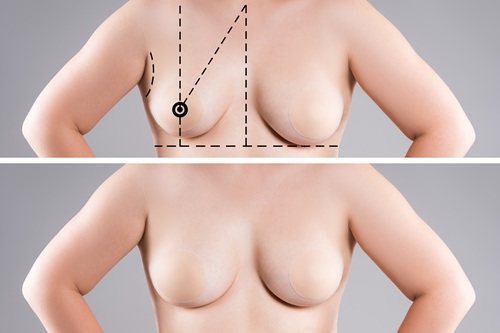
How We Assess You
Our assessment is built around listening first, then examining carefully.
We begin with your history and your goals: why you are considering removal, your symptoms, your implant details, and what you hope to feel and see afterward. Bringing your implant cards or any past operative records, if you have them, is genuinely useful here.
Next is a focused physical exam of your breasts, the overlying skin, and the surrounding tissue. When a silicone rupture is a possibility, we may recommend imaging such as ultrasound or MRI, in keeping with regulatory guidance for monitoring silicone implants.
We also screen for warning signs. New, late fluid collection around an implant, an unexplained lump, or sudden swelling can occasionally point to a rare implant-associated condition that requires a specific work-up before any elective surgery. If we see anything that needs further investigation, we will arrange the appropriate imaging, testing, or specialist referral rather than proceed prematurely.
From there, we move into shared decision-making, where we review photos to demonstrate outcomes, lay out the options, the benefits, and the trade-offs so the plan reflects your priorities. Our flow is simple: assess, plan, then proceed together.
What to Expect: From Consultation to Recovery
Your complimentary consultation usually runs comfortably long enough to cover your history, an exam, and a full discussion of options. Please bring any implant records and a list of your questions. There is no pressure to book surgery on the day.
On surgery day, breast implant removal is typically performed under general anesthesia. The length depends on whether capsule removal, a lift, a fat transfer, or a replacement is included. Small drains are sometimes placed to reduce fluid build-up, and You will go home the same day in most cases with a supportive surgical garment.
In the early recovery period, expect soreness, swelling, and bruising that ease over the first couple of weeks. Many women take roughly one to two weeks off work, depending on their job and whether additional procedures were performed. Heavy lifting and strenuous exercise are restricted for several weeks.
Follow-up visits let us monitor healing, remove any drains or sutures, and track your comfort and results over time. Your home plan is kept simple and realistic: rest, gentle movement, garment use, and clear instructions on what to watch for.

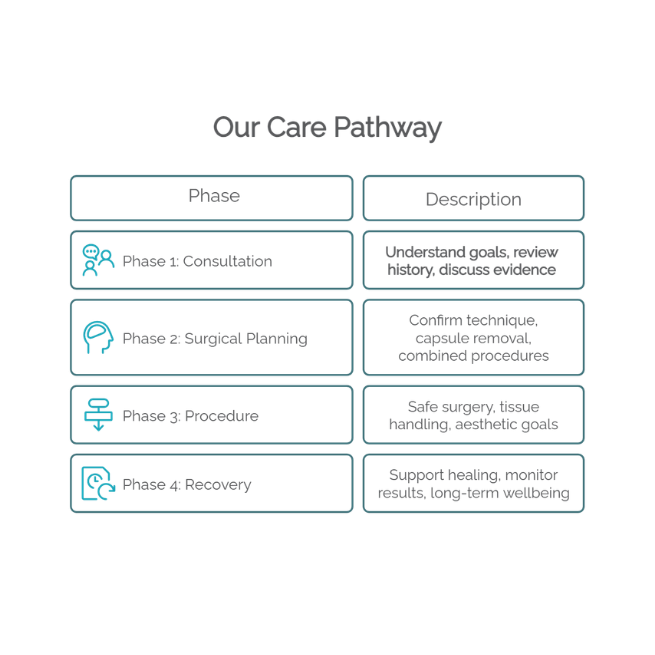
Our Care Pathway
We use a clear, four-phase pathway, then personalize it to you.
Phase 1: Consultation and shared decision-making. We start by understanding your goals and concerns, reviewing your implant history, and discussing what the evidence does and does not support. This is where we decide together whether removal makes sense, and if so, what kind.
Phase 2: Surgical planning and preparation. We confirm the specific technique, whether capsule removal is indicated, and whether a lift, fat transfer, or replacement should be combined. We review pre-operative steps and set realistic expectations for shape and recovery.
Phase 3: The procedure. Surgery is carried out with attention to safety, careful tissue handling, and your aesthetic goals. We remove only what your situation calls for.
Phase 4: Recovery, follow-up, and long-term wellbeing. We support you through healing, monitor your results, and remain available for questions. For women who removed implants because of symptoms, we keep expectations honest and check in on how you are feeling.
Every pathway is individualized. Two women with the same starting point can end up with different, equally appropriate plans, and that is by design.
Surgical Options We Offer
We tailor the technique to your anatomy and goals. Options include:
- Implant removal alone (explant): taking out the implant while leaving a healthy, thin capsule in place when removal of the capsule is not indicated.
- Removal with total capsulectomy: removing the implant and the full capsule, often appropriate for advanced capsular contracture or silicone rupture.[4]
- Removal with partial capsulectomy: removing the implant and part of the capsule when that is the most reasonable approach.
- En bloc or total intact capsulectomy: removing the implant and capsule as one sealed unit, a technique reserved for suspected or confirmed implant-associated cancer after appropriate work-up.[3]
- Removal with a breast lift: repositioning and tightening the breast for a more youthful shape after the implant is out.
- Removal with fat transfer: restoring modest volume using your own fat.
- Removal with implant exchange: swapping older implants for new ones when you wish to stay augmented.
- Drain placement when needed: to reduce post-operative fluid and support healing.


Featured Procedures
Total Capsulectomy
What it is: complete removal of the scar tissue capsule along with the implant. Who it is for: women with advanced capsular contracture, an intracapsular silicone rupture, or those who, after a full discussion, choose capsule removal.[4] What to expect: a somewhat longer operation than implant removal alone, with a similar recovery arc. How it fits in: it is often the most appropriate level of capsule surgery when removal is indicated, and it does not require the more extensive en bloc technique to be effective. Safety notes: capsule removal carries more risk than leaving a thin, healthy capsule in place, so we recommend it only when the benefits justify it.
Breast Implant Removal With a Lift
What it is: explant surgery combined with a breast lift (mastopexy). Who it is for: women whose skin and breast tissue will look deflated or sag once the implant is removed. What to expect: additional incisions and a longer recovery than removal alone, in exchange for a lifted, reshaped result. How it fits in: it addresses the common worry of “what will my breasts look like afterward.” Safety notes: suitability depends on your tissue quality and skin elasticity, which we assess at your consultation.
Breast Implant Removal With Fat Transfer
What it is: explant surgery paired with fat transfer to add gentle, natural volume. Who it is for: women who want to soften the volume loss of going implant-free without new implants. What to expect: liposuction from a donor area plus careful fat grafting, with results that settle over a few months. How it fits in: it is a natural-feeling alternative to staying augmented. Safety notes: the amount of volume achievable with fat is modest and varies by individual, so we set expectations carefully.
Our Commitment to Safe, Informed Breast Implant Removal
We practise evidence-informed care. That means our recommendations follow current data and the guidance of established plastic surgery societies, not trends or marketing.
We prioritize informed consent, shared decision-making, and performing the right operation for your situation. We are transparent that, while many women report symptom improvement after removal, the evidence on systemic symptoms is still developing, and outcomes cannot be guaranteed.[1] Research to date suggests that for women removing implants because of symptoms, improvement does not depend on having the most extensive capsule surgery.[4]
We avoid blanket guarantees, one-size-fits-all surgery, and promoting en bloc capsulectomy as a routine treatment for systemic symptoms, because leading societies reserve that technique for suspected or established implant-associated cancer.[3] When your assessment raises any concern that needs oncology, pathology, or advanced imaging input, we refer out promptly. Your safety comes before any procedure.
A De-Identified Patient Story
Profile: a woman in her forties with silicone implants placed over a decade earlier.
Starting concern: increasing firmness and discomfort on one side, with worry that something was wrong.
Assessment highlights: the exam suggested capsular contracture, and imaging raised the possibility of a contained rupture. No warning signs of any implant-associated condition were found.
Plan: after a full discussion of options, she chose implant removal with total capsulectomy on the affected side and removal on the other, combined with a breast lift to address sagging.
Milestones: by week one she was comfortable in her garment and managing well at home; by weeks two to three she had returned to desk work; by week six she was easing back into exercise.
Outcome: she described relief from the firmness and discomfort, and felt more like herself in her clothing. Results like this are individual, and your experience may differ.
Maintenance: routine follow-up and ongoing breast awareness, with an open door for any future questions.

Real Patient Experiences With Our Practice

Dr. Nancy de Kleer
Founder & Director
Dr. Nancy de Kleer is the founder and director of Oakville Plastic Surgery and Advanced Skincare. A board-certified plastic surgeon, Dr. de Kleer has extensive training in both reconstructive and cosmetic procedures. Born and raised in the Greater Toronto Area (GTA), Dr. de Kleer is committed to Ontario healthcare. She attended undergrad at the University of Western Ontario where she graduated with honours. Earning her medical degree (honours) from the University of Toronto, Dr. de Kleer was accepted into the prestigious plastic and reconstructive surgery residency program and continued her medical training with the University of Toronto. Following her five-year surgical residency, Dr. de Kleer remained in Toronto working as a trauma surgeon at St. Michael’s Hospital before opening the doors of Oakville Plastic Surgery in 2005. [Learn More]
Cost, Financing, and What Is Included
Breast implant removal for cosmetic reasons is generally not covered by provincial health insurance. Some situations, such as certain medically necessary cases, may be assessed differently, and coverage rules can be specific to your circumstances, so we encourage you to confirm your own eligibility directly.
After your consultation and exam, we provide a clear, itemized quote based on your individual plan, because the cost depends on whether capsule removal, a lift, a fat transfer, or a replacement is included. Surgical fees, anesthesia, and facility costs are reviewed with you in advance, with no surprises.
We offer payment plan options to help make care more manageable. Your consultation includes a thorough assessment, a discussion of your options, and answers to your questions.

Breast Implant Removal: What to Expect
Video Summary: Thinking about explant surgery? Dr. de Kleer explains what breast implant removal involves, why women choose it, how we assess each patient, and your options afterward, from a lift to fat transfer. Removal is not one size fits all, and your plan should be yours.
Download Your Breast Implant Removal Patient Guide
Thinking about removing your implants? Our free patient guide walks you through the basics of explant surgery, common reasons women choose removal, what to expect, and the options that may be available to you.
Download the Patient Guide
Frequently Asked Questions
Do I need a referral to be seen?
A referral is not required to book a consultation with us. If your situation involves a possible medical issue, we can coordinate any further work-up as needed.
Will my symptoms go away after removal?
Many women report feeling better, but the evidence on systemic symptoms is still emerging, and improvement cannot be guaranteed. We will always be honest with you about what the data does and does not show.
Do I need an “en bloc” capsulectomy?
For most women, no. Leading plastic surgery societies reserve en bloc capsulectomy for suspected or confirmed implant-associated cancer. When capsule removal is indicated for other reasons, a total capsulectomy is usually the appropriate approach.
How long is recovery?
Most women take about one to two weeks off work, with strenuous activity restricted for several weeks. Combined procedures, such as a lift, lengthen recovery somewhat.
Will my breasts look deflated after removal?
This depends on your tissue and how long the implants were in place. A breast lift or fat transfer can be combined with removal to restore a pleasing shape, which we will discuss at your consultation.
How do I know if my implant has ruptured?
A saline rupture is usually obvious because the breast deflates. A silicone rupture can be silent and is often detected only on imaging such as ultrasound or MRI.
Can I remove and replace my implants in one operation?
Yes, removal and exchange can often be done together if that is your goal. We will confirm whether it is appropriate for you.
Is breast implant removal covered by OHIP?
Cosmetic removal is generally not covered. Certain medically necessary situations may be assessed differently, so please confirm your eligibility for your specific case.
When should I seek urgent care?
Contact a medical professional promptly for rapid swelling, a new lump, persistent fluid build-up, fever, spreading redness, or severe pain.
Do you have removal examples?
Photos of past patients are available at the office during your appointment. As each case is a personal journey, there are many options with implant removal and we can go through each outcome.
Ready to Talk? Book Your Breast Implant Removal Consultation in Oakville
The best first step is a thorough, no-pressure assessment. We will examine your concerns, walk you through the evidence, and help you build a plan that fits your goals and your timeline.
What happens next is simple: book your complimentary consultation, and we will take the time to answer every question before you decide anything.
Medical References
- U.S. Food and Drug Administration. Risks and Complications of Breast Implants. (Systemic symptoms sometimes called breast implant illness are reported but poorly understood; no proven association with connective tissue disease, breast cancer, or reproductive problems.) https://www.fda.gov/medical-devices/breast-implants/risks-and-complications-breast-implants
- U.S. Food and Drug Administration. What to Know About Breast Implants, and 2025 Medical Device Reports update on systemic symptoms and breast implant-associated lymphoma. (Implants are not lifetime devices; imaging guidance for silicone ruptures; boxed warnings.) https://www.fda.gov/consumers/consumer-updates/what-know-about-breast-implants
- American Society of Plastic Surgeons. Breast Surgery Collaborative Community Consensus Statement on Breast Implant Capsulectomy Definitions and Management. (En bloc capsulectomy is indicated only for suspected or established implant-associated cancer after appropriate work-up.) https://www.plasticsurgery.org/news/press-releases/breast-surgery-collaborative-community-issues-consensus-statement-on-breast-implant-capsulectomy-definitions-and-management
- Is capsulectomy necessary for symptom improvement in patients undergoing implant removal for systemic symptoms? National Library of Medicine (PMC). (Symptom improvement after removal did not depend on the extent of capsulectomy; total capsulectomy indicated for advanced capsular contracture and intracapsular gel rupture.) https://pmc.ncbi.nlm.nih.gov/articles/PMC11340222/
This page is for general education and does not replace personalized medical advice. Individual results, recommendations, and recovery vary based on your needs, medical history, and circumstances.
